ERP & Automation
Processing Incoming Invoices Automatically: What E-Invoicing Solves — and What It Doesn't
Few digitalization topics have occupied Germany’s mid-sized companies lately as much as e-invoicing. Since January 1, 2025, German businesses must be able to receive e-invoices in B2B transactions; the obligation to issue them follows in stages — from 2027 for companies with more than €800,000 in prior-year revenue, from 2028 for essentially everyone. The obvious conclusion: the problem of manual invoice entry will solve itself — all you have to do is wait.
That conclusion is half right — and the wrong half is expensive. This article sorts out what e-invoicing actually solves, which documents will remain unstructured for years to come, why Switzerland is a special case, and what an invoice intake looks like that handles both.
What the e-invoicing mandate actually covers
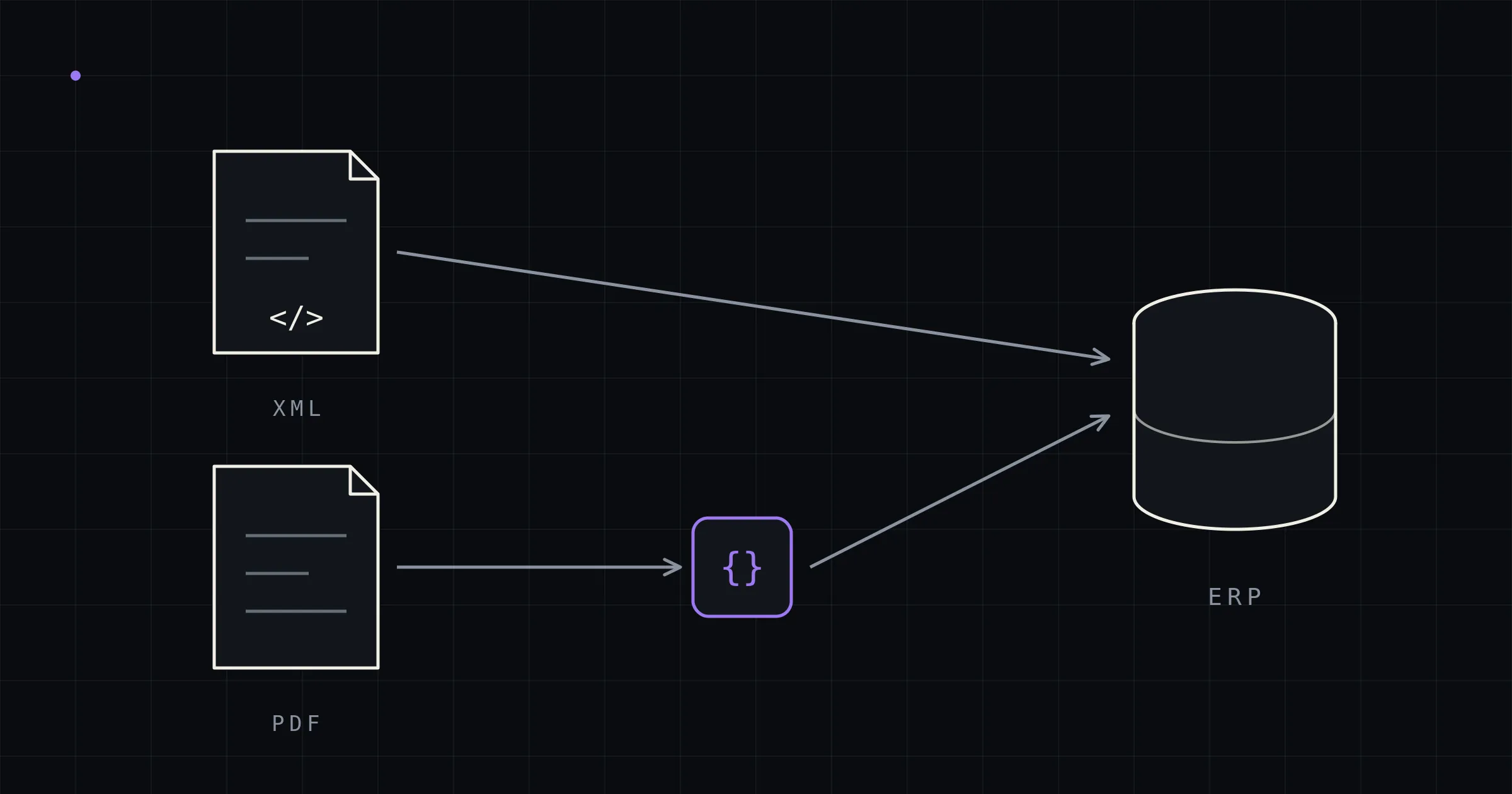
An e-invoice under the German rules is a structured data record compliant with EN 16931 — in practice: XRechnung (pure XML) or ZUGFeRD (a PDF with embedded XML). These invoices need no text recognition and no AI: the ERP or accounting system reads the data straight from the structure, and many systems post them automatically after rule-based checks. For this document type, extraction technology is simply unnecessary — and any serious architecture treats it accordingly (more on that below).
The German timeline, as of June 2026:
| Date | Obligation |
|---|---|
| since Jan 1, 2025 | All domestic B2B companies must be able to receive e-invoices |
| from Jan 1, 2027 | Issuing obligation for companies with > €800,000 prior-year revenue |
| from Jan 1, 2028 | Issuing obligation for essentially all companies; exemptions include low-value invoices (≤ €250), tax-exempt supplies, and small businesses |
The gaps: which invoices will remain PDFs
In practice, invoice intake will stay mixed well beyond 2028 — for structural reasons:
- Foreign suppliers. The mandate covers domestic transactions between domestic companies. Invoices from suppliers in Switzerland, the US, or China will keep arriving however their systems generate them — usually as PDFs.
- The transition years. Until the end of 2026 (or 2027 for smaller issuers), paper and plain PDFs remain permissible with the recipient’s consent. The real-world invoice mix shifts gradually, not on a cutoff date.
- Exemptions. Low-value invoices, small businesses, tax-exempt supplies — together, a constant residual stream of unstructured documents.
- Documents that aren’t invoices. Order confirmations, delivery notes, credit notes, price lists, payment reminders — entirely untouched by the regulation. Automating your invoice intake is a long way from automating your document intake.
- The backlog. Archives, ongoing projects, legacy contracts: retroactive digitization and migration projects also work with unstructured documents.
Switzerland is different: no mandate, no deadline
Swiss companies — and every DACH company with Swiss suppliers — operate in a different reality: there is no B2B e-invoicing mandate, and none has been adopted. Electronic invoicing is only mandatory toward the federal administration (for contract values above CHF 5,000, since 2016).
The QR-bill, the standard in Swiss payments since 2022, is frequently misunderstood here: the Swiss QR code structures payment information — IBAN, amount, reference — but not the invoice content. Line items, quantities, prices, and tax rates still exist only as printed text on the document. For accounts payable, that means the QR-bill speeds up paying, not capturing. Anyone in Switzerland who wants line-item data from incoming invoices in their ERP will need extraction for the foreseeable future — there is no regulatory lifeline to wait for.
The right architecture: a hybrid invoice intake
From this mixed picture follows a clear architectural principle: structured data gets processed structurally, and AI only touches the documents that genuinely need it. A well-built invoice intake sorts at the entrance — never behind it:
- Intake and routing: Every file is identified (hash, duplicate check) and classified. XRechnung and ZUGFeRD go down the deterministic path — parse the XML, validate, done. No model, no uncertainty, no cost.
- Extraction path for the rest: Unstructured PDFs (domestic and foreign, backlog, edge cases) run through AI extraction: layout parsing, schema-bound extraction, then the same checks applied to all documents.
- Shared validation: Regardless of path, the same rules apply — arithmetic correctness (net + tax = gross, line totals = invoice total), matching against purchase order and vendor master data, mandatory invoice details under German VAT law (Section 14 UStG) or the Swiss VAT Act. Only this layer turns “data captured” into “document verified.”
- Automation with a review queue: Whatever passes all checks gets posted or proposed for payment; anything uncertain lands pre-filled with a human.
The appeal of this architecture: it gets cheaper every year instead of obsolete. As the e-invoice share grows, more documents move to the deterministic path — the pipeline stays the same, only its AI share shrinks. Conversely, anyone buying a pure OCR solution for invoices today is buying a shrinking problem; anyone building the entire document intake is buying a growing capability. The bigger lever beyond invoices is covered in the article on automated order entry; the full picture is in the guide to document automation.
The economics: why a hybrid intake pays off now anyway
Industry analyses (including Billentis) put the process cost of a manually handled incoming invoice at €15 to €40; automated, it drops to around €4. At 500 incoming invoices per month, the capture savings alone are in the range of €60,000 to €90,000 per year — on top of that come early-payment discounts captured through faster approval and double payments avoided through proper duplicate checks.
What matters for the investment case: these savings don’t depend on the AI share. Even the automated processing of structured e-invoices needs to be connected, validated, and integrated into approval workflows — the pipeline is the same investment, and extraction is just one of its components. And where documents must not leave the building, all of it runs fully on-premise.
Frequently asked questions
Will we even need invoice extraction after 2028? For standard domestic German B2B invoices: increasingly not — those will arrive structured. For foreign suppliers, Swiss business, exempt cases, and every non-invoice document: yes. The sensible setup is an architecture that processes structured documents deterministically and uses extraction only for the unstructured remainder.
Isn’t our ERP system’s e-invoicing feature enough? For receiving and importing XRechnung/ZUGFeRD, often yes. The gaps lie elsewhere: free-form PDF invoices, foreign documents, purchase orders, delivery notes, order confirmations — and in the validation and approval logic that goes beyond mere import.
What applies to Swiss companies? No B2B mandate, no adopted deadline. The QR-bill structures payment data only, not line items. Anyone who wants line-item data in their ERP needs extraction — today and for the foreseeable future.
Isn’t ZUGFeRD just a PDF? ZUGFeRD is a hybrid format: a PDF for humans with embedded XML for machines. The XML is always what should be processed — running OCR on the PDF when structured data is embedded is a design flaw.
How do we handle the transition period? That’s exactly what the hybrid intake is built for: it accepts any mix of paper scans, PDFs, and e-invoices and routes each document down the right path. No pressure on suppliers to change anything.
Conclusion
E-invoicing is genuine progress — and partial progress. It structures one document type in one country, with transition periods and exemptions, while the rest of the document intake stays unstructured and Switzerland operates with no mandate at all. The robust answer is not an either-or choice between e-invoicing and extraction, but a hybrid document intake: deterministic where structure exists; AI-assisted and validated where it doesn’t; the same checks for everything.
kitun builds hybrid document intakes as custom ERP modules — e-invoice processing and template-free PDF extraction in one pipeline, on-premise, with direct ERP integration. For a first assessment of your own invoice intake: a 20-minute call.