ERP & Automation
EDI for Small Business Partners: Why PDF Extraction Is the Realistic Alternative
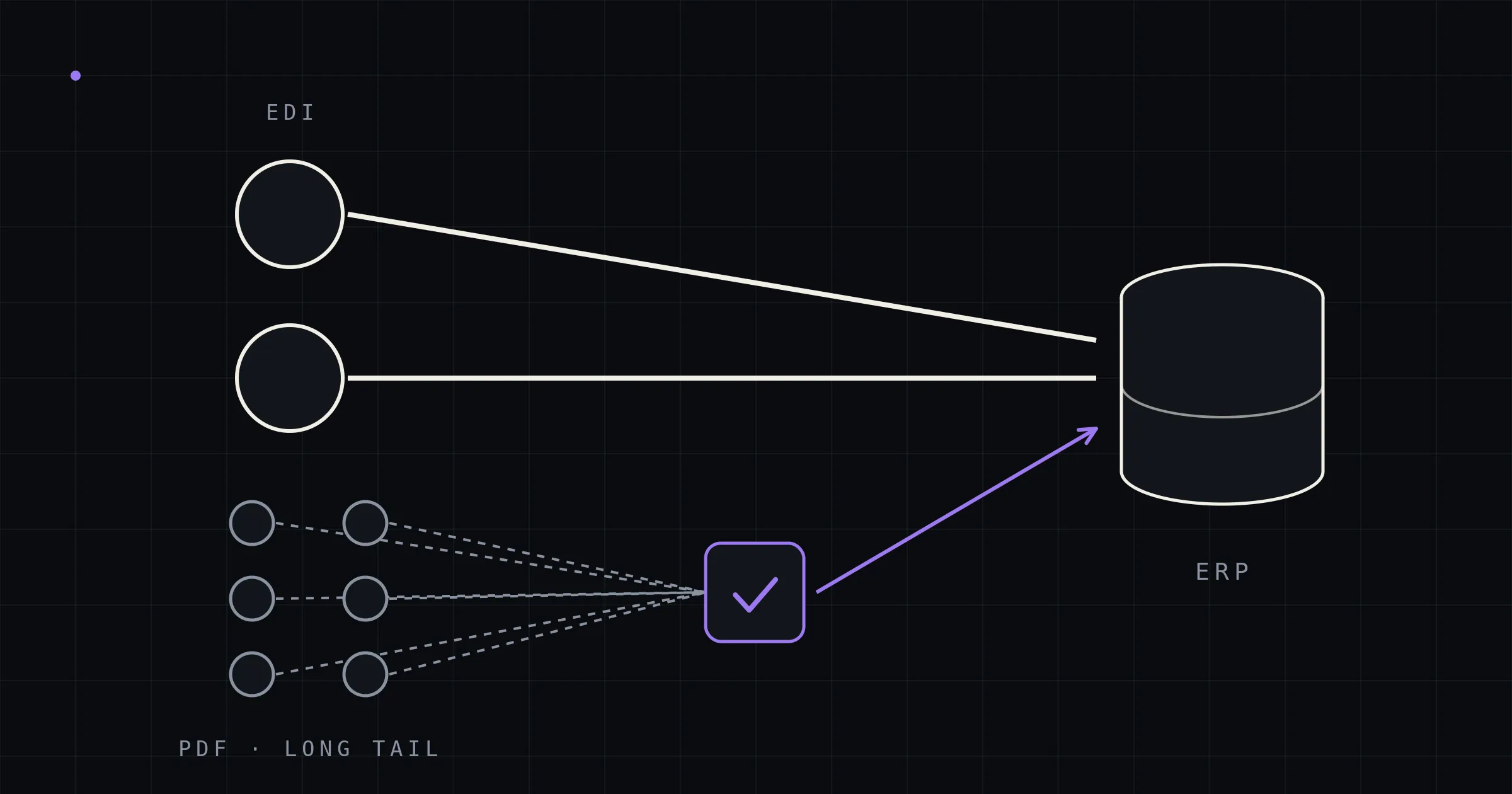
Electronic data interchange between ERP systems — EDI — has been the gold standard for automated business processes for decades: purchase orders, order confirmations, dispatch advices, and invoices flow from system to system without human involvement. Where EDI runs, there is no rekeying, no transmission errors, no latency.
The uncomfortable truth sits in the word “where”: in most mid-sized companies, EDI runs with a handful of partners — and everything else arrives as a PDF by email. This article explains why that is not negligence but economic logic; why WebEDI and portals do little to change it; and how the long tail of the partner list can be automated today anyway.
Why EDI fails in the long tail: a cost calculation
An EDI connection is not a switch you flip — it’s a project, per business partner. Aligning formats (EDIFACT, ANSI X12, industry-specific subsets), defining field mappings, running test cycles with both sides, resolving edge cases, setting up operations and monitoring. Depending on complexity and service provider, the cost per connection runs from four to five figures, plus ongoing fees for transmission or clearing — plus maintenance whenever a partner changes systems.
That math tips quickly. An example with realistic numbers: a customer who orders twelve times a year generates roughly €72 in capture costs per year with manual entry (8 minutes at €45/h fully loaded). Even an inexpensive €3,000 EDI connection takes decades, on paper, to pay for itself against those €72. For a key account placing twenty orders a day, the picture flips entirely — there, the same connection pays for itself in weeks.
That’s why the EDI landscape looks the same across the mid-market, and rightly so: the top 5 to 20 partners are connected, the remaining 80 to 95 percent of the partner list are not — and never will be. The problem: this long tail collectively often sends 20 to 50 percent of the document volume. These are exactly the documents being rekeyed today.
WebEDI and portals: shifting the problem, not solving it
The industry’s answer to the long tail is called WebEDI: the small business partner gets a web portal where they manually enter their orders, order confirmations, or delivery data. Technically, this produces a clean EDI message. Practically, it’s human data entry — except now the partner does the typing instead of your own sales support team.
The results follow accordingly. For the partner, the portal is a foreign system with no integration into their workflows: they enter every order twice — once in their own ERP, once in the customer’s portal. Anyone supplying several key accounts, each with its own portal, juggles a dozen logins and interfaces. The outcome is familiar: reluctant adoption, input errors, documents that end up arriving by email anyway. WebEDI works where a powerful market player can apply pressure — in typical mid-market business between partners on equal footing, it rarely works well.
The core of the problem: both approaches — classic EDI and WebEDI alike — demand that the business partner change their behavior. That is the most expensive currency in B2B.
The third way: treat the PDF like an EDI message
And yet the starting position is better than its reputation. The PDF the partner sends isn’t chaos — it’s a machine-generated, cleanly structured document straight from their ERP system. All the data of an EDI message is in there; it’s just encoded as layout instead of as a data record. Modern, template-free AI extraction decodes exactly that: it reads the document regardless of the sender’s layout, transfers the values into a strict target schema, and hands off to the ERP — after the same checks an EDI message would go through.
The EDI analogy is more precise than it first sounds, because a robust pipeline takes over every role of an EDI connection:
- The mapping is handled by the extraction model — but template-free: new senders need no setup, changed layouts no re-mapping. The “connection effort per partner” that makes EDI uneconomical in the long tail is structurally eliminated.
- The syntax check is handled by the enforced target schema (constrained decoding): the output is guaranteed to be well-formed.
- The plausibility check is handled by deterministic validation — line-item arithmetic, matching against item and partner master data, verifiability of every value in the source document.
- Error handling is handled by a review queue instead of an EDI clearing ticket: uncertain documents land pre-filled with a human who decides in seconds.
For the business partner, what changes is: nothing. They order, confirm, and deliver exactly as they always have. That’s precisely why this approach works where portals fail. (Order intake, the most important use case, is covered in detail in the article on automated order entry.)
When real EDI is still the right answer
Honesty is part of the deal: PDF extraction does not replace EDI everywhere, and it shouldn’t.
- High-volume, long-term relationships — the customer with twenty orders a day, the logistics partner sending dispatch advices by the minute — belong on a real EDI connection. Determinism beats extraction wherever the connection pays for itself.
- Industries with mandatory EDI (automotive, large retail chains) leave no choice anyway: if you want to supply, you support the required standards.
- Real-time processes like just-in-time call-offs need guaranteed machine latency, not email inboxes.
The realistic target architecture is therefore coexistence: EDI for the partners where it pays off — extraction for everyone else. Both paths feed into the same validation and the same ERP processes; the ERP cannot tell (and doesn’t care) whether an order originated from an EDIFACT message or a PDF. The full picture of this architecture is drawn in the guide to document automation.
Frequently asked questions
Is PDF extraction as reliable as EDI? EDI is deterministic and remains the benchmark for connected partners. For the long tail, a validated extraction pipeline achieves what matters operationally: documents flow through automatically, and no error slips through unnoticed — arithmetic checks, source grounding, and a review queue make sure of that. Compared to the manual entry that serves the long tail today, the difference is dramatic on both counts.
Can we move partners to EDI later? Yes — and better informed: the pipeline delivers volume and quality data per sender. If a partner eventually justifies a real connection, that becomes a targeted project instead of a gut decision.
What about outgoing documents? Extraction concerns the inbound side. Outbound (order confirmations, invoices), your own ERP generates structured data — there, e-invoicing and classic EDI are the right channels. Combining both directions yields a fully automated document flow.
Is it worth it with only a few PDF documents per day? The economics depend on volume and the cost of errors. From around 10–20 documents a day, the case is usually clear-cut; below that, it depends — a quick stocktake of your document intake usually answers it within an hour.
Conclusion
That EDI only reaches your biggest partners isn’t carelessness — it’s arithmetic: connection cost per partner versus document volume per partner. The long tail of the partner list simply couldn’t be automated until now — portals merely shift the work onto the partner. Template-free PDF extraction with deterministic validation closes exactly this gap: it treats the PDF as what it is — an EDI message in the wrong clothes — while letting business partners work the way they always have.
kitun builds these pipelines as custom ERP modules — on-premise, template-free, coexisting with existing EDI connections, without per-document pricing. Whether your own document intake justifies it: a 20-minute intro call will tell.